
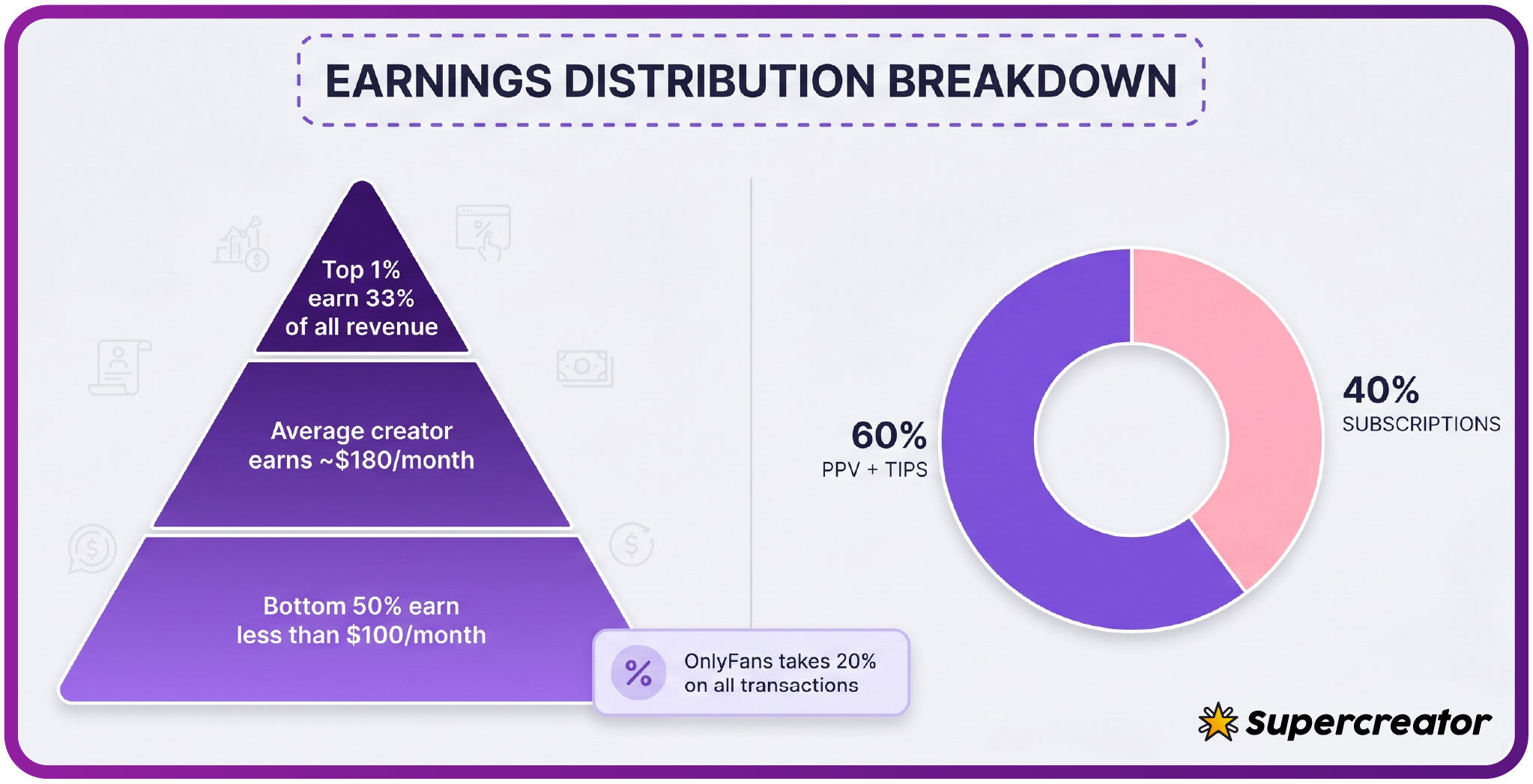
Free OnlyFans accounts do not charge a subscription, but they still earn money through pay-per-view messages and tips. That single fact explains why so many locked messages arrive in your inbox every week. This article explains how to read the price attached to each unlock before you pay it.

A locked message is a small purchase, and like any purchase it rewards a few seconds of thought. Comparing price bands, message frequency, and preview quality helps subscribers avoid regret unlocks. The goal is not to spend nothing; it is to spend on the messages that actually match what you hoped to see.
Millions of accounts now sit on the platform, and most free pages follow the same basic model. Understanding that model makes each price tag easier to judge.
Why PPV pricing varies so much
A free page sets its subscription price to $0 and earns through pay-per-view messages and tips instead. Paid pages follow a different path: subscriptions run from $4.99 at the minimum to $49.99 at the maximum, with most paid pages sitting between $4.99 and $15 and averages landing around $5 to $10. There is no base price below $4.99, though promotional first months may dip under that line.
Because a free page has no subscription income, every locked message carries the full weight of its revenue. That is why two pages with similar audiences can send very different prices. The platform takes a 20% fee on everything, including subscriptions, tips, and pay-per-view unlocks, and the creator keeps 80%. A creator pricing an unlock is therefore thinking about what lands in their pocket, not the number on your screen.
- Audience size: a large following can price lower and still earn well across many unlocks.
- Posting volume: creators who post daily often need higher prices to justify the time.
- Niche demand: specialized content supports steadier pricing than general content.
- Production effort: edited sets and longer videos cost more to make than single photos.
- Bundle size: a set of twenty images and a single image cannot share one price.
- Seasonality: prices shift around holidays, events, and personal schedules.
None of these factors is a moral judgment. They are simply the variables a creator balances when setting a number, and knowing them helps you predict what a page will charge over time.

Reading the price before the preview
A locked message usually shows the price first, then a caption or teaser, then the unlock button. Read in that order and you give yourself a chance to stop before emotion takes over. The price is the only fixed fact in the message; everything else is designed to make the unlock feel natural.
Check the number against the stated contents before you tap anything. If the caption promises a short clip and the price sits at the top of the range, that mismatch is information. If the caption describes a full set and the price sits at the bottom, that is also information.
| Signal | Clear example | Weak example |
|---|---|---|
| Price shown up front | $6 listed before any teaser text | Price hidden until after a long caption |
| Contents described | “12 photos and a 3-minute clip” | “something special, just for you” |
| Preview visible | A clear thumbnail that matches the caption | A blurred frame that could be anything |
| Message frequency | One paid offer per day at most | Several paid offers within an hour |
Subscription mechanics matter here too. When a creator raises the subscription price, auto-renew stops, and existing access lasts until the current paid period ends. The same pattern of notice applies to recurring charges on paid pages, so a price change never traps you mid-cycle.
Practical tip: decide your reaction to a price before you open the message. If you already know that anything above $10 gets skipped, the caption cannot talk you into a different answer.

Common price bands and what they signal
Prices cluster, and the clusters carry meaning. A page that consistently charges $5 is telling you something different from a page that consistently charges $25. Tracking the band a creator lives in is more useful than judging any single message.
| Band | Typical contents | What it usually signals |
|---|---|---|
| $4.99 to $8 | Single images or short clips | High volume, frequent small offers |
| $9 to $15 | Photo sets or short videos | Standard pricing for regular posters |
| $16 to $29 | Longer videos or themed sets | More production time per post |
| $30 to $49.99 | Bundles, series, or custom work | Occasional high-effort releases |
Remember that the platform fee of 20% applies to unlocks just as it does to subscriptions. A $25 unlock returns $20 to the creator, which puts the number in context when you compare it with the effort described.

Preview quality as a signal
The preview is not decoration; it is the seller’s own summary of the product. A sharp thumbnail that matches the caption tells you the creator expects the contents to speak for themselves. A blurred or reused image tells you the opposite.
Captions and descriptions carry equal weight. Specific language about length, count, and format is a commitment the creator can be held to. Vague language leaves room for a message that technically matches nothing in particular, which is exactly the outcome you want to avoid.
- A thumbnail that never changes across multiple paid messages.
- A caption that repeats the same phrase week after week.
- No description of length, count, or format.
- Urgency wording that claims the offer expires within minutes.
- Previews that show less than the free posts on the same page.
Run the same check against the free feed before you unlock anything. If the free posts already look thin, the paid ones rarely improve on them.

Frequency of offers
How often a page sends paid messages changes the real monthly cost far more than any single price. Ten unlocks at $6 is $60, which most subscribers never plan for when they open the first message. The platform has no built-in discovery feed or directory, which is why ranking sites exist to help users compare pages in the first place.
BestOnlyFans and similar directories list pages by category, but no directory changes the math inside your inbox. Only your own counting does that. Track the offers for two weeks before deciding whether a page is affordable.
- Low frequency: one to three paid offers per week.
- Medium frequency: roughly one offer per day.
- High frequency: several offers per day across a week.
- Burst frequency: many offers in a single day, then silence.
- Renewal cost: recurring subscriptions on top of any unlocks.
A practical approach is to log each offer for a month and add the totals. The result is usually more honest than any impression formed from individual messages.

Setting a personal unlock ceiling
A ceiling is a single number you decide in advance and do not renegotiate inside a message. Many subscribers find that a per-message limit of $10 keeps the habit sustainable, while still allowing regular unlocks. The exact figure matters less than the fact that it was chosen calmly.
Holding the line gets easier when the rule is written down somewhere outside the app. Pressure works best in the moment, which is exactly when a pre-set number is most useful. BestOnlyFans lists and similar resources help with page selection, but they cannot enforce a budget for you.
If the prices on a page sit above your ceiling every week, that is not a willpower problem. It is a mismatch between the page and your budget, and the honest response is to stop opening its paid messages.
- Write the ceiling in a note before you subscribe to anything.
- Close the message and wait ten minutes before deciding.
- Track the month total in a simple list.
- Unfollow or mute pages that consistently exceed the limit.
- Recheck the ceiling once a month rather than once a day.
Account settings are worth a look for a second reason: two-step authentication protects the payment method attached to your account, which matters once unlocks and tips become routine. Turn it on before your first paid message, not after.
When to skip an unlock entirely
Skipping is a normal part of using free pages, not a failure. The model depends on some subscribers passing on some offers, and creators price accordingly. A missed unlock costs you nothing; a regretted one costs money and attention.
Waiting is often the stronger move. Prices on the same page sometimes fall during promotional periods, and the first month of a paid subscription may dip below the usual minimum. Patience occasionally produces the same content for less.
Use the login path at onlyfans free login to check your message history and see how a page has priced offers over time. Patterns are easier to spot in a list than in memory.
- Unlocking because the message says the offer expires in minutes.
- Paying for a preview you cannot actually see.
- Ignoring the monthly total while judging each message alone.
- Treating a high price as proof of high quality.
- Subscribing to several paid pages before checking the renewal dates.
A short review of past unlocks teaches more than any general advice. Look at the last ten purchases and ask how many still seem worth the price. BestOnlyFans readers who do this exercise usually find their own answer faster than any ranking list can provide it.
FAQ
Can a free page charge a subscription later?
Yes. A creator can change the price, and when the subscription price rises, auto-renew stops while existing access lasts until the current paid period ends.
What is the lowest real subscription price?
The minimum is $4.99. Promotional first months may dip below that, but there is no base price under $4.99.
How much of an unlock does the creator keep?
The platform fee is 20% on subscriptions, tips, and pay-per-view unlocks, so the creator keeps 80%.
Why do free pages send so many paid messages?
Free pages earn through pay-per-view messages and tips rather than subscriptions, so each locked message is a direct source of income.